Four Engineering Patterns for GPL Code Isolation and Their Legal Boundaries
Why Copyleft Licenses Give Engineers Headaches
The GPL family — GPL v2, GPL v3, LGPL, and AGPL — is everywhere in the open source ecosystem. Their core logic is "same-license propagation": any code that forms a "combined work" with GPL-licensed code must be released under equivalent terms. For commercial software teams, this creates a tripwire that can be triggered at any moment.
The trouble is that the boundary of "combined" has never been precisely defined in law. The Free Software Foundation's interpretive documents are the most authoritative reference available, yet they still leave considerable room for interpretation. Court decisions — Versata v. Ameriprise, the BusyBox litigation series, and others — reveal more about the cost of non-compliance than they do about where the safe boundary lies.
The typical engineering response is: "We use GPL libraries but it's fine — we've isolated them." But "isolation" conceals an enormous range of practices: some approaches are legally defensible; others are little more than an engineer's intuition. The goal of this article is to unpack the four mainstream isolation patterns, clarify the contagion boundary each one draws, and identify which approaches do not actually constitute effective isolation in legal terms.
---
Four Isolation Patterns: Engineering Implementation and Contagion Boundaries
### Pattern 1: Process Isolation
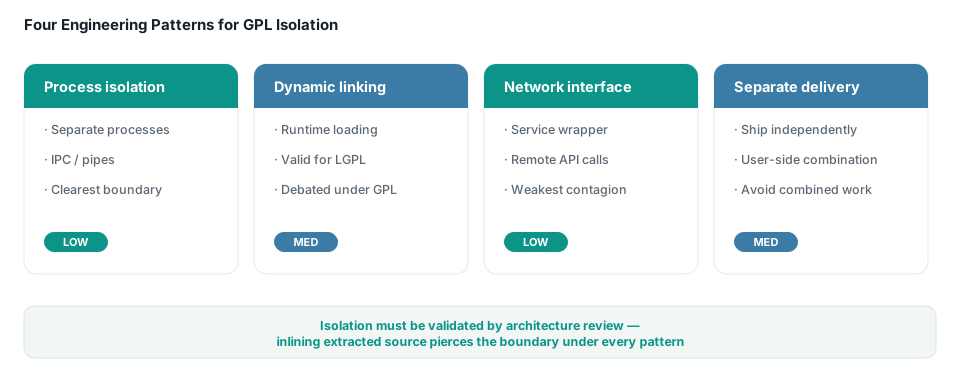
Engineering approach: Deploy the GPL component as a separate operating system process. Commercial code interacts with it exclusively through inter-process communication (IPC) — pipes, Unix sockets, shared-memory message queues — and the two sides exist as entirely independent executables with no shared compilation step.
Contagion boundary analysis: Process isolation is one of the lowest legal-risk options available. The FSF's position is that independent processes communicating over a well-defined protocol do not constitute a "single program" and therefore do not trigger GPL propagation. The critical factor is engineering-level independence: the two processes must be capable of running independently, being distributed independently, and the interface protocol must not be designed as a highly customized, proprietary coupling.
Review checklist: Verify that the IPC interface is documented as a general-purpose protocol. Confirm that both codebases can be compiled and tested in isolation. Confirm that deployment artifacts are genuinely separate.
---
### Pattern 2: Dynamic Linking
Engineering approach: Commercial code loads the GPL/LGPL library at runtime (.so / .dll) rather than linking it statically at compile time.
Contagion boundary analysis: A critical distinction must be drawn between GPL and LGPL here. LGPL explicitly permits dynamic linking — the clause was designed precisely for this use case. For GPL v2/v3, however, whether dynamic linking constitutes a "combined work" remains actively contested. The FSF's official position is that both static and dynamic linking can trigger copyleft propagation; the difference is merely one of evidentiary difficulty. The Linux kernel community has adopted a "syscall exception" interpretation that allows user-space programs to interact with the kernel via system calls, but this is a kernel-specific carve-out — it cannot be generalized to other GPL libraries.
High-risk misconception: Many teams assume that "dynamic linking = safe isolation." This is one of the most prevalent misconceptions in the field. If the library in question is licensed under GPL (not LGPL), dynamic linking alone is insufficient to establish effective isolation. The determination must account for the library's specific license version and any applicable exception clauses (such as the Classpath Exception).
---
### Pattern 3: Network Interface Isolation
Engineering approach: Wrap the GPL component as a standalone service and expose its capabilities over a network protocol such as HTTP, gRPC, or REST. Commercial code acts as a client calling that service. The two may physically reside on the same host, but they communicate exclusively through the standard network stack.
Contagion boundary analysis: For GPL v2 and GPL v3, a network interface is generally treated as effective isolation — the client and server are independent programs communicating over a standard protocol and do not form a single work. AGPL, however, was drafted specifically to close this gap. AGPL's core provision is that "network use constitutes distribution": anyone who makes AGPL software available over a network must provide the corresponding source code to network users. Consequently, if the encapsulated component is licensed under AGPL, network interface isolation does not block propagation; it merely shifts the compliance obligation from "linked code" to "service operation."
Review checklist: Confirm the encapsulated component's exact license (GPL v2, GPL v3, and AGPL v3 differ in material ways). Assess whether the service is exposed to external users. Verify that the network interface definition is sufficiently general and does not imply tight coupling.
---
### Pattern 4: Separate Distribution
Engineering approach: The GPL component is released as a fully independent software package with its own version number, its own installer, and its own documentation. The commercial product's user manual documents the dependency and instructs users to install the GPL component themselves.
Contagion boundary analysis: This pattern carries the heaviest compliance documentation burden but is theoretically among the lower legal-risk approaches. The key requirement is that the independence must be genuine: if the commercial software's installation script automatically downloads and installs the GPL component, or if the GPL component's functionality is so deeply integrated that users cannot perceive them as distinct products, a court may still find a combined work. The legal effectiveness of separate distribution depends on users experiencing the two components as genuinely independent products.
This pattern is common in embedded and industrial software contexts and is an architectural decision that must be planned early, as discussed in Open Source Intake Strategy.
---
Common Misconceptions: These Practices Do Not Constitute Effective Isolation
Engineering practice is rife with widely circulated but legally unsound beliefs about isolation. Architecture reviews should actively look for these:
- "We added an abstraction layer, so there's no direct dependency": Introducing an abstraction layer — an interface class, an adapter pattern — within the same process and the same compilation unit does not alter the linking relationship and does not constitute isolation. GPL propagation is determined by the linking state at distribution time, not by the architectural patterns in the code.
- "We only use the GPL library in test code; it doesn't go into the production build": This claim fails unless the test dependency is genuinely excluded from the distribution artifact. If test code shares the same codebase and is distributed under the same license, the distinction does not hold.
- "We're SaaS — we don't distribute software, so GPL doesn't apply": This is accurate for GPL v2/v3 but completely inapplicable to AGPL. Using AGPL components in a SaaS context still requires making the source code available.
- "We copied the code but modified it extensively, so it qualifies as a new work": This reflects a misunderstanding of "derivative work." A work derived from GPL-licensed code remains a derivative work regardless of how extensively it was modified.
- "We purchased a commercial license, so we're not using the GPL version": The reasoning itself is sound, but it is contingent on confirming that the commercial license actually covers every version in use and every use case. License Conflict Detection in Practice documents several compliance failures caused by version oversights of exactly this kind.
---
A Checklist Framework for Architecture Review
Embedding GPL isolation review into Architecture Decision Records (ADRs) is the foundation of systematic risk management. The following dimensions should be covered in every review.
Dependency identification layer: Start by precisely identifying the exact license version of each component. Different versions of the same component may carry different licenses (e.g., GPL v2 only vs. GPL v2+). Snippet-level detection capability is essential here — Snippet-Level SCA vs. Manifest Scanning explains why relying solely on pom.xml or package.json misses the license attribution of a large volume of actual code fragments. CleanSource SCA performs snippet-level detection against a 3T+ code fingerprint database, identifying GPL code fragments that have been modified or copy-pasted rather than relying exclusively on declared component metadata.
Isolation validity layer: Using the four patterns described in this article as a reference, verify that the isolation mechanisms declared in architecture documentation are genuinely implemented, and screen for the misconceptions enumerated above.
Distribution scenario layer: Evaluate every distribution form the product takes — source release, binary release, container image, SaaS service — because each carries different compliance obligations. For binary distribution scenarios, CleanBinary provides binary composition analysis that can identify the presence of GPL components without access to source code.
Obligation fulfillment layer: Where GPL dependencies are confirmed and cannot be fully isolated, a compliance fulfillment path must be planned: obtaining and preserving complete corresponding source code, preparing written offers, and ensuring the completeness of copyright notices. This phase is often the most neglected in practice.
Continuous monitoring layer: License compliance is not a one-time review. Component updates can bring license changes, and newly introduced dependencies can circumvent existing isolation schemes. CleanSource SCA CE Community Edition provides continuous dependency monitoring suitable for establishing automated compliance gates in CI pipelines. Practical guidance can be found in CI/CD Compliance Gate Practice.
---
Isolation Is an Engineering Judgment and a Legal Judgment
There is no universally "safe" solution for GPL isolation. Process isolation offers the clearest legal logic in most scenarios but adds operational complexity. Dynamic linking is LGPL-friendly but contested for GPL. Network interface isolation is effective against GPL but fails against AGPL. Separate distribution requires genuine independence — not merely a documentation-layer declaration.
Engineering teams need to accept a fundamental reality: until the law is fully settled, effective GPL isolation demands that engineering implementation and legal judgment work in concert. License considerations must be factored into architectural decisions at the design stage, not patched in as last-minute compliance fixes before a product ships.
As the EU CRA becomes fully applicable in December 2027, SBOM completeness requirements will significantly raise the evidentiary burden for license compliance — isolation schemes must be verifiable at the SBOM level. Verbally asserting isolation will no longer be sufficient. Engineering teams need to build an auditable, traceable chain of compliance evidence.
---
*This article was produced by Sectrend Research. For information on tooling support for GPL compliance reviews, see Open Source License Governance Best Practices or contact the Sectrend technical team.*