How to Build an Enterprise Open-Source Intake Policy: From Review Committees to Automated Gates
The Review Committee Bottleneck: A Structural Problem
An architecture committee at a mid-sized internet company meets every two weeks to review open-source intake requests. The agenda routinely stacks a dozen or more component proposals, each getting an average of eight minutes of discussion. Experts score by instinct, decisions go out in an email, and everything is archived somewhere on a shared drive. Three months later, when the security team is chasing down a vulnerability, nobody can say with certainty when the offending component was approved, or who signed off on it.
This is not an isolated story. As microservice architectures proliferate and AI-assisted coding goes mainstream, teams are pulling in open-source components far faster than traditional governance mechanisms can respond. A Stanford University controlled experiment found that developers using AI coding assistants tend to feel *less* confident about their code's security—yet their actual output is *more* insecure. Veracode's 2025 research reinforces this: roughly 45% of AI-assisted tasks introduce OWASP-class defects. Dependencies quietly dragged in by code-generation tools never pass through any human review at all.
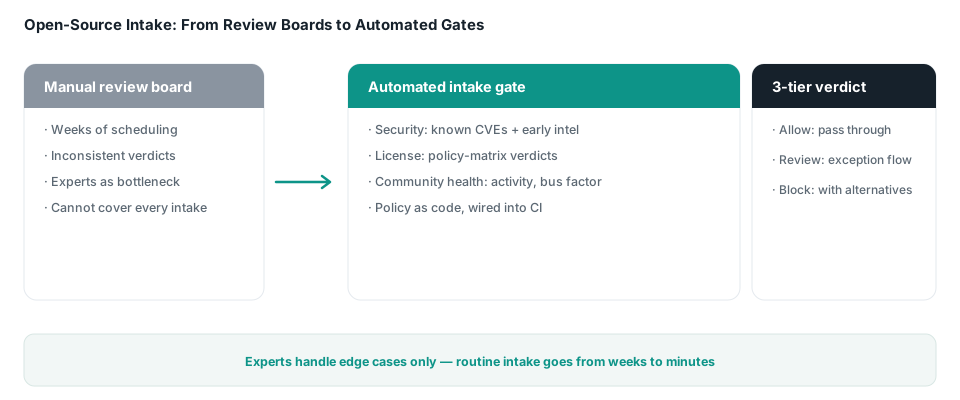
The real problem is not that review committees are insufficiently diligent. It is that there is a structural mismatch between the granularity of the governance mechanism and the velocity of component intake. The answer is not to abolish the committee, but to redraw the boundary of human judgment—hand off rule-bound decisions to automated gates, and reserve the genuinely ambiguous cases for expert deliberation.
Evaluation Dimensions: Three Axes, All Non-Negotiable
Before designing an automated policy, you need a clear answer to a more fundamental question: what exactly does evaluating an open-source component require? In practice, three core axes matter.
Security is the most intuitive, but it is routinely oversimplified into "run a CVE scan." That is not enough. The capability gap between snippet-level SCA and manifest-level SCA determines how much real risk you can actually surface—manifest scanning misses transitive dependencies and code-snippet reuse, which happen to be the primary hiding places for supply chain attacks. Log4Shell (CVE-2021-44228), which erupted in December 2021, had such a massive blast radius precisely because countless systems had pulled in Log4j through indirect dependencies that manifest-only tools simply could not see. The xz backdoor (CVE-2024-3094) in March 2024 drove the point even further: malicious code can be meticulously inserted through legitimate community contribution workflows, and vulnerability databases offer no coverage for that.
License compliance is routinely underestimated by engineering teams, yet it is the dimension that keeps legal and procurement up at night. The GPL family, AGPL, and SSPL can trigger strong copyleft obligations depending on how a component is used; MIT and Apache 2.0 are permissive, but mixing them still requires careful handling of patent grants and attribution requirements. License conflicts are not theoretical—license conflict detection in practice documents cases where multi-layer dependency stacking produces compatibility issues that only surface during legal review, at considerable cost.
Community health is the axis most easily overlooked by automated tools, yet it directly determines a component's long-term maintainability. The signals worth tracking include maintainer activity, recent commit frequency, issue response times, whether a formal security disclosure process exists, and whether the project has entered end-of-life (EOL) status. Python 2 reached EOL in 2020, AngularJS in 2022, and Log4j 1.x as far back as 2015—EOL open-source risk accumulates silently in legacy systems and is a significant source of technical debt. Community health has a second dimension as well: the event-stream poisoning (2018), ua-parser-js (2021), and the Shai-Hulud npm worm in September 2025 all demonstrated repeatedly that single-maintainer projects or low-activity communities face a disproportionately elevated risk of supply chain hijacking.
Engineering the Policy Matrix: Writing Rules Into the Pipeline
With the evaluation dimensions defined, the next step is translating decision logic into executable code—specifically, automated gates in the CI/CD pipeline. The core logic of the policy matrix is risk-tiered disposition, not a binary block-or-pass approach.
A workable tiered framework looks roughly like this:
- Block: Known high or critical vulnerabilities with no available fix; license terms that clearly conflict with the company's business model (e.g., shipping a SaaS product while pulling in an AGPL component); components matching known malicious package names or exhibiting typosquatting characteristics.
- Need Review: Medium-severity vulnerabilities with documented mitigations; weakly copyleft licenses (e.g., LGPL) requiring context-dependent assessment; community activity below threshold but not yet EOL; version lagging behind the mainline release by more than a defined interval.
- Pass: No known vulnerabilities; license on the approved whitelist (MIT, Apache 2.0, BSD, etc.); community health metrics within normal range.
This tiered logic maps directly onto the engineering practice of SCA gates in CI pipelines. CleanSource SCA is backed by a data foundation of 320 million components, 270,000+ vulnerability intelligence records, and 600+ package management ecosystems, and delivers results with sufficient confidence within 60 seconds of incremental scanning—with a false positive rate below 15%. That last figure is the prerequisite for a policy matrix to actually hold in a real pipeline: tools with excessive false positive rates train developers to ignore alerts, and the gate becomes meaningless.
The policy matrix itself must be version-controlled and subjected to the same code review and change-logging discipline as production code. Every policy adjustment should carry a timestamp and an owner. This is both an internal governance requirement and the foundational evidence you will need when facing regulatory scrutiny under frameworks like the EU CRA (effective December 10, 2024; fully applicable December 11, 2027).
Exception Workflows and Cross-Functional Interfaces
Automated gates handle decisions that fall cleanly within the rules. But outside the rule boundary, exceptions are inevitable—business urgency, prohibitively high cost of technical alternatives, license situations that require commercial negotiation. The quality of the exception workflow often determines whether the entire intake system earns long-term buy-in from engineering teams.
A classic antipattern: the exception request process is more painful than "just hiding the component in a directory the scanner doesn't cover," so developers choose the latter. A well-designed exception workflow should:
- Present a structured request form that requires the applicant to document the component's intended use, the results of alternative evaluations, the expected usage duration, and an explicit risk acknowledgment
- Keep the approval chain short and transparent—typically no more than two approval levels, with automatic escalation if no response arrives within the defined window
- Bind every approval to a time limit, setting an expiration date on the exception and automatically triggering a reassessment before it lapses
- Record all exceptions in the SBOM so they remain traceable during compliance reviews
Interface with procurement: Open-source intake screening should complete before the procurement process begins. For components with commercial open-source dual-licensing arrangements (certain databases and message queues, for example), license evaluation conclusions must flow to the procurement team as input for commercial negotiations—not surface after a contract is signed.
Interface with legal: Legal teams generally do not have the capacity to review component licenses one by one, and they should not be expected to. The design goal of the intake policy is to push license conflict detection upstream into tooling, distill the genuinely ambiguous cases that require legal interpretation, and forward only those—not dump the entire component inventory on legal counsel. PureStream provides this kind of layered filtering in AI compliance governance contexts, helping legal teams focus their attention on the cases that actually require judgment.
In financial services, the compliance pressure on open-source governance is compounded by regulatory reporting obligations. Guidance jointly issued by the People's Bank of China and four other agencies in October 2021 sets explicit governance expectations for financial institutions' use of open-source software, making completeness and traceability of the SBOM a prerequisite for compliance review. SBOM generation and maintenance must be a standard output of the intake process—not documentation retrofitted after the fact.
From Gate to Capability: A Long-Term View of Policy Adoption
Engineering the policy matrix and wiring in the exception workflow gives you the skeleton of an open-source intake policy. Making the system actually function requires several complementary capabilities.
First, legacy remediation and incremental intake control must work in tandem. Gates block newly introduced risk, but problems already present in historical inventory do not disappear on their own. CleanSource SCA CE offers a free community edition as a starting point for legacy asset discovery, giving teams an initial inventory view without additional procurement pressure.
Second, binary-level coverage is non-negotiable in certain contexts. In scenarios where teams are pulling in compiled artifacts or SDKs rather than source packages, manifest-level scanning fails completely. CleanBinary fills this gap in binary composition analysis—a capability especially critical in embedded, automotive, and medical device contexts. Automotive open-source compliance and medical device SBOM compliance each carry specific hard requirements: UN R155 on the automotive side, and on the medical device side the FDA's Section 524B provision, in effect since March 2023, which will not accept a submission without an SBOM.
Third, developer capability must grow in parallel. Tools and processes can intercept known problems, but building developers' baseline judgment about open-source risk reduces the total volume of problems that need intercepting in the first place. SkillSec structures security capability assessment through an E1–E5 evidence grading system and a block/need_review/pass audit mechanism, giving organizations a precise view of where their gaps are—rather than discovering them in a post-incident retrospective.
An open-source intake policy is not a one-time policy release. It is an engineering capability that must evolve continuously alongside the threat landscape, regulatory requirements, and organizational scale. Moving from review committees to automated gates is fundamentally about transforming judgment that lives scattered across emails and meeting notes into code that is executable, auditable, and traceable. There are no shortcuts—but the path is clear.