Not just detection — judge and fix the moment AI writes each line of code
The AI engine understands business logic, data flows, and permission boundaries — moving code security from after-the-fact scanning to real time, and replacing legacy SAST.
The legacy paradigm of static analysis was built on rule matching; in an age when AI produces code 10× faster, it is bound to fail
An AI-native engine that re-architects code security, collapsing detection, judgment, and repair into one developer turn.
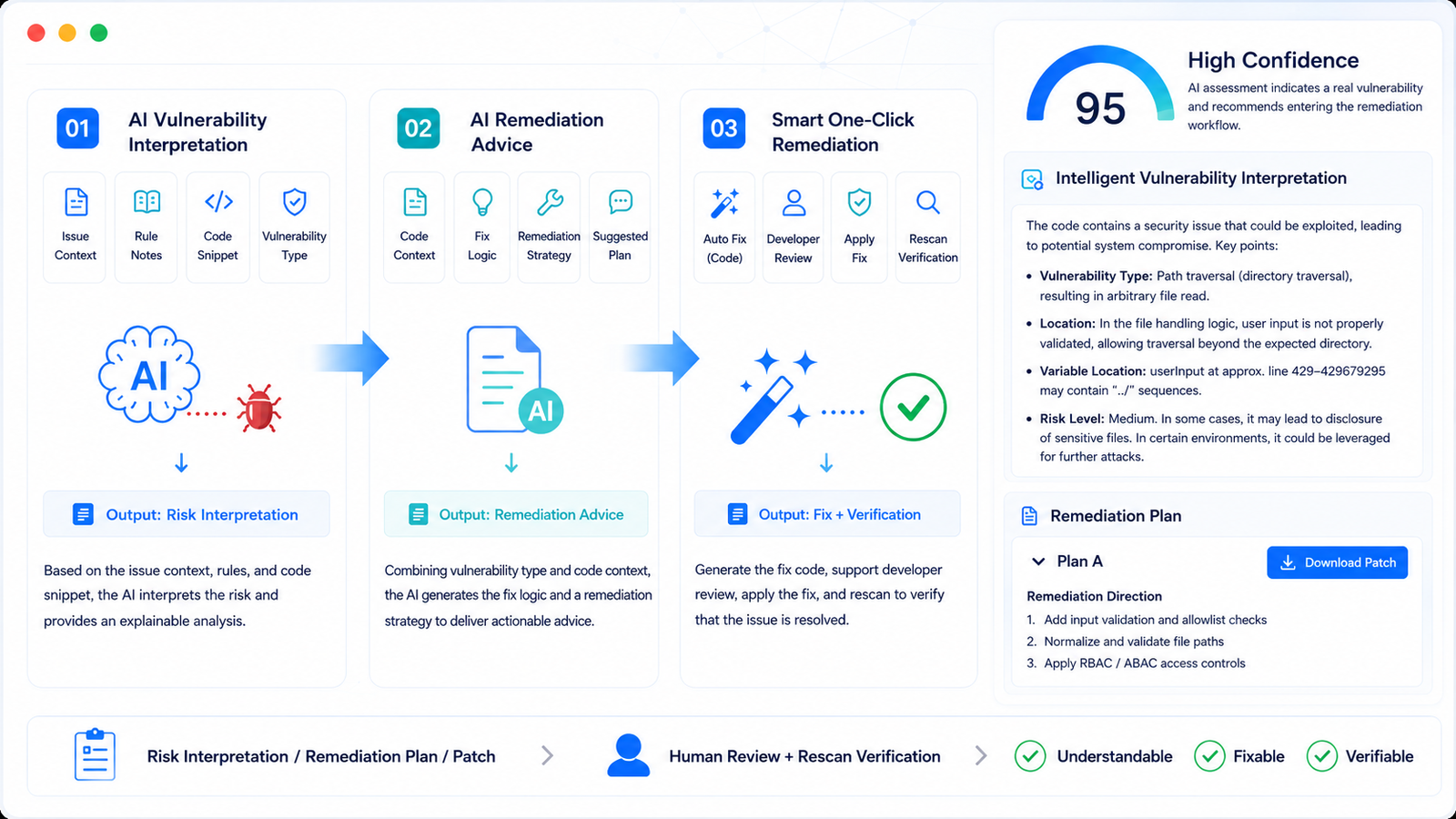
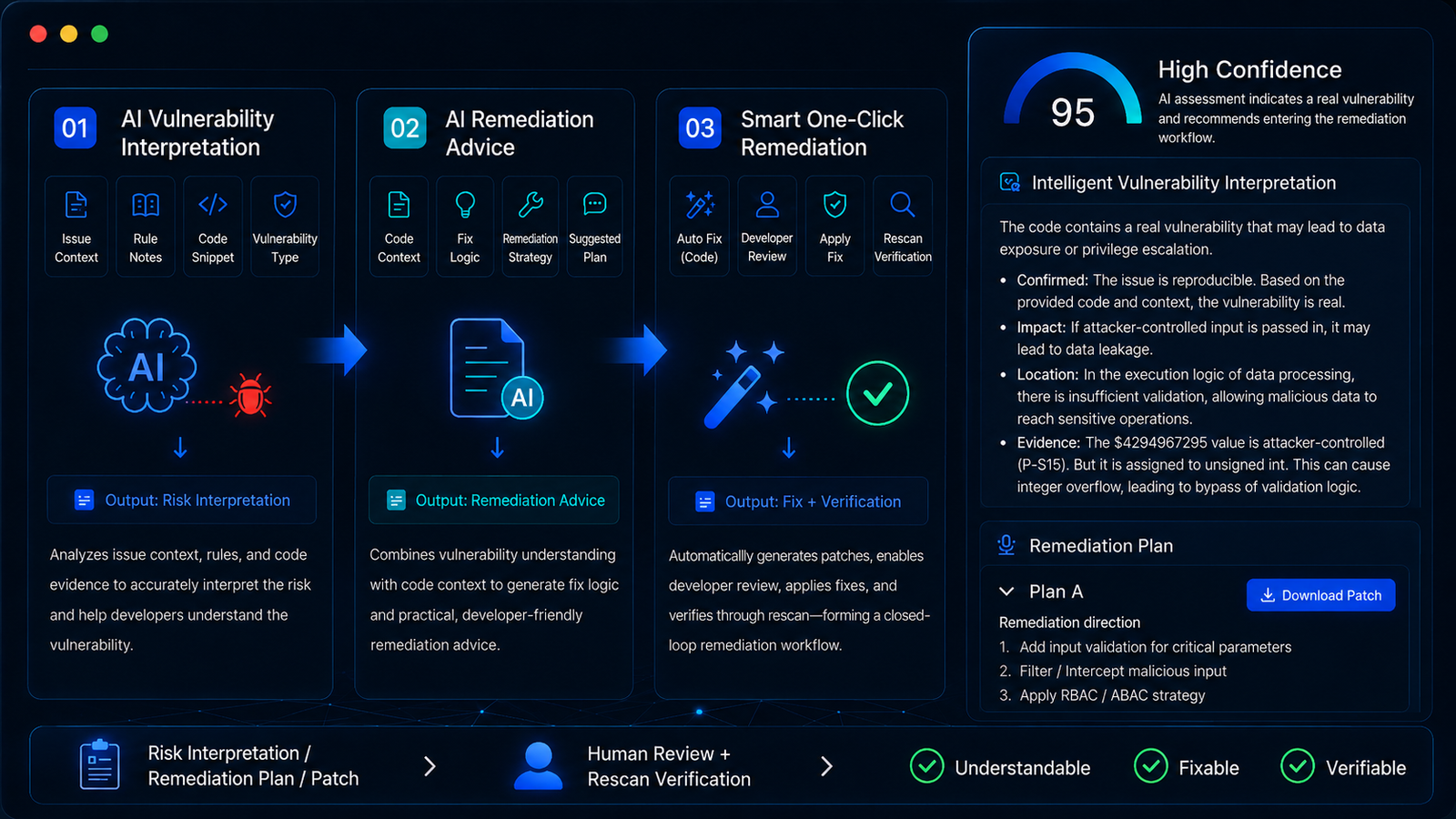
Deep data-flow and control-flow analysis tracks sensitive data, permission boundaries, and auth bypass to pinpoint truly exploitable vulnerabilities.
Beyond pattern matching — contextual understanding of business semantics cuts noise so engineers focus on real risk, not alert triage.
One-click jump from web into the IDE; an AI agent proposes a fix, a human confirms, and a rescan closes the loop — no more 'found it, now what?'.
Purpose-built rules for the high-frequency flaws of AI-generated code: insecure defaults, missing validation, hardcoded credentials.
Extends coverage into Agent scenarios, detecting new supply-chain and prompt-injection risks in MCP tool integrations and AI Skills.
PR/MR-level incremental scans finish in seconds without blocking; configurable gates block high-risk merges, compatible with mainstream quality-gate systems.
Deep data-flow and control-flow analysis traces sensitive data, permission boundaries, and authentication bypasses to pinpoint vulnerabilities that are actually exploitable.
Tracks untrusted input from source to a dangerous sink along the data flow.
Uses branch conditions and auth boundaries to drop unreachable / sanitized paths.
Reports only triggerable vulns — fewer false positives, fix high-risk first.
No deferring to review: detection, repair, and regression verification all happen within the same turn the developer writes code — a continuous closed loop.
Risks surfaced as you type, not at pipeline time.
Delivers applicable patches, not just alerts.
Re-scans after the fix to confirm nothing new broke.
Security judgment and repair happen in lockstep with AI coding.
Human- or AI-written code; scanning triggers on write and on commit.
The AI engine understands business logic and data flow, locating real exploitable risk and explaining the cause.
In-IDE AI proposes a patch; the developer confirms; fixes land now, not in backlog.
A rescan verifies the fix, visualized, ensuring the issue is truly closed.
Studies keep finding that roughly 40% of AI-generated code contains exploitable flaws — while developers using AI assistants feel more confident. The data, four mechanisms, and a governance path.
As code is mass-produced by AI and dependencies are pulled in automatically by agents, the old
Supply-chain poisoning is spreading from npm packages to MCP servers and Agent Skills. A review of xz, Shai-Hulud and postmark-mcp — and why malware detection is no longer enough.
Traditional SAST relies on rule matching, with high false positives and no semantic understanding. CleanCode Security Agent uses an AI engine that understands business logic, sensitive data flows and permission boundaries, closing detection, triage and repair in one turn — under 15% false positives, incremental scans under 60 seconds, a drop-in replacement for legacy SAST.
20+ mainstream languages including Java, Python, Go, C/C++ and JavaScript, covering injection, privilege escalation, sensitive-data exposure and other major defect classes.
Yes. CleanCode is built for the AI-coding era: it detects and fixes issues in real time as developers or AI assistants write code, preventing vulnerabilities introduced by vibe coding.
IDE plugins plus CI/CD integrations such as Jenkins and GitLab CI, with on-premises deployment supported — shifting security left inside your existing DevSecOps pipeline.
Fully offline on-premises deployment is supported — code and scan results stay inside your network, meeting the data-security requirements of financial institutions and state-owned enterprises.
Legacy tools match rules line by line with no business context. CleanCode's AI engine understands call chains, data flows and permission boundaries, triages before reporting, and attaches an explainable evidence chain — keeping false positives under 15%.
Submit a request via the website's trial form; the Sectrend team will arrange a demo and a POC environment so you can validate recall and precision on your own codebase.
Book a demo and see how CleanCode Security Agent protects code in real time inside your pipeline.
 商务合作
商务合作
 微信公众号
微信公众号
