Dependency Pinning in Practice: What Lockfiles Do and Do Not Protect
An over-trusted mechanism
“We use a lockfile, our dependencies are pinned.” This sentence appears frequently in security reviews, usually treated as an answer that ends the discussion.
Lockfiles do matter. But what they solve is build consistency: making today's build install exactly the same dependency tree as a build three months from now. Several distinct problems sit between that and “our dependencies are safe.”
What lockfiles do protect against
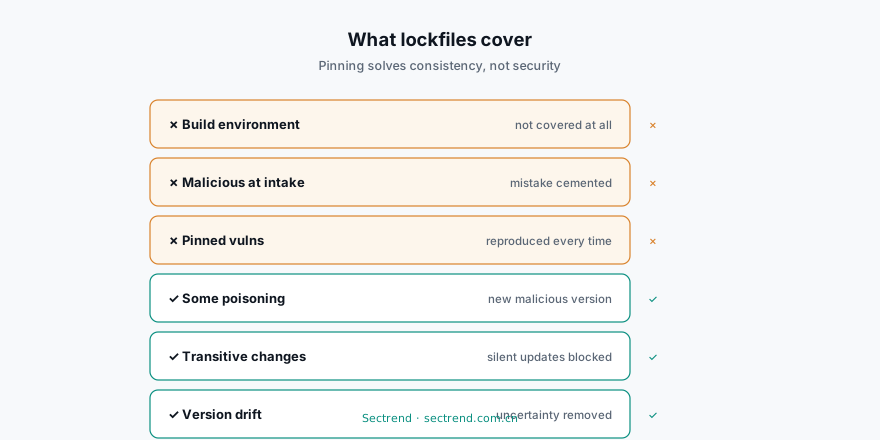
Version drift. Without a lockfile, a semver range like ^1.2.0 resolves to the newest compatible version at every install. Two developers, or a developer and CI, can end up with different code. Lockfiles eliminate that uncertainty.
Unexpected transitive changes. Your direct dependency did not change, but one of its transitive dependencies published a new version — without a lockfile that enters your build silently. This class of change is behind many “it worked yesterday” failures.
Some poisoning scenarios. When an attacker poisons by publishing a new malicious version — one of the most common patterns — projects pinned to an older version are not automatically affected. This is real security value from lockfiles, but it is passive and conditional.
What lockfiles do not protect against
Vulnerabilities already pinned in. The most direct point: if the version you pinned is itself vulnerable, the lockfile will faithfully and reproducibly install that vulnerability every single time. Pinned is not safe; pinned is consistent. Worse, a lockfile makes it less likely you will notice, because there is no longer a version change to prompt a look.
Packages that were malicious at intake. A lockfile pins what you already decided to use. If the intake decision itself was wrong — a typosquatted package, a hallucinated package name from an AI assistant — the lockfile simply cements that mistake.
Content substitution within the same version. Most ecosystems record integrity hashes in the lockfile (npm's integrity field, for instance), which prevents tampering. But if your lockfile was generated in an already-compromised environment, or the hash was computed over malicious content, pinning loses its meaning — the root of the trust chain has to be clean.
Attack surface outside the dependency tree. Build scripts, CI configuration, registry mirrors, the compiler itself — lockfiles address none of it. A SolarWinds-style build compromise never needs to touch the dependency tree.
The risk of staleness itself. Ironically, using lockfiles well introduces a new problem: dependencies go unupdated for long stretches and security patches never arrive. Pinning and updating need to be balanced, not chosen between as extremes.
Practices that have to accompany pinning
1. Pinning plus continuous scanning, never separated.
A lockfile provides a precise dependency inventory, which is exactly the ideal input for continuous vulnerability matching. Make the lockfile the object your SCA scans, so that when new intelligence lands you can immediately answer whether you are affected. The value of pinning is only fully realized alongside monitoring — otherwise it merely freezes the risk in place.
2. Lockfile changes go through code review.
Every lockfile change means the dependency tree changed. That should be an explicit decision someone sees, not a build-time byproduct. Review questions: who introduced it, why, and what transitive dependencies came along.
3. Tiered update policy.
Patch versions can update automatically (security fixes usually land at this level), minors after tests pass, majors always with human evaluation. With Dependabot or Renovate, updates become small daily steps rather than an annual cleanup.
4. Internal mirror plus integrity verification.
Route all dependencies through an internal registry, combined with lockfile integrity hashes, for a dual guarantee of “determined content, controlled source.” This also neutralizes dependency confusion attacks along the way.
5. Separate development from runtime dependencies.
Lockfiles usually contain both, but their risk profiles differ: runtime dependencies enter the production attack surface directly, while dev dependencies affect the build environment. Setting different update cadences and review intensity puts limited attention where it matters more.
Calibrating expectations
Lockfiles are infrastructure for reproducible builds and a necessary condition for dependency management — but not a sufficient one. Understand them as a determinism tool rather than a security tool, and you will naturally go on to add what is actually missing: continuous vulnerability monitoring, explicit intake decisions, and protection for the build environment itself.
In one sentence: a lockfile guarantees you install the same thing every time; SCA is what tells you whether that thing has a problem.
---
Further reading: Configuring SCA gates in CI pipelines · Four ways npm malware hides · Dependency management entries in our Open Source & SBOM Guide