Software Supply Chain Security for Semiconductors: Full-Stack Transparency from Firmware to SDK
Say "semiconductor supply chain security" and most people picture wafers and lithography. But chip companies run a second, equally critical supply chain: software. A modern SoC ships with firmware, drivers, BSPs, toolchains and SDKs measured in tens of millions of lines, with open source making up a large share. And here is the twist: chip companies are not merely consumers of open source — they are distributors of software at scale. Your SDK is integrated into the products of hundreds of downstream customers; your firmware is flashed into hundreds of millions of devices. Distribution activates open-source obligations in full, and customer compliance reviews flow upstream to your door.
Four ways the industry is different
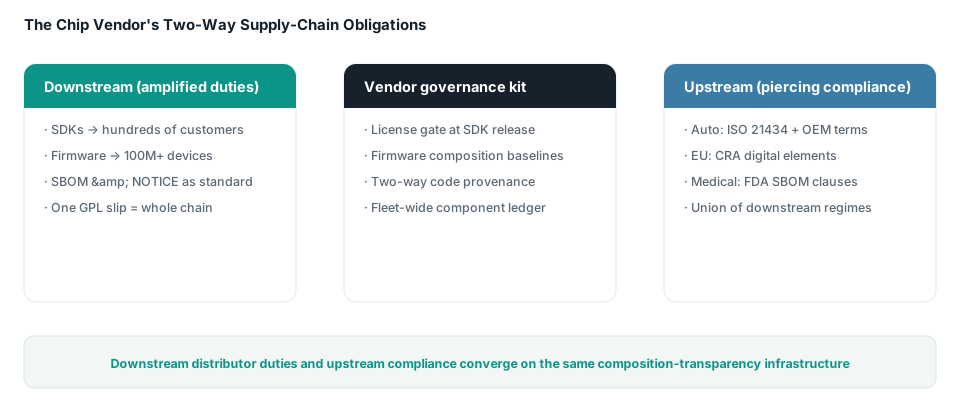
One: SDK distribution amplifies license obligations. A chip vendor's SDKs and reference designs are integrated directly into end products by downstream customers — so every open-source component and every copied sample snippet inside the SDK propagates its license obligations to hundreds of customers. A single GPL contamination is not one product's problem; it is a problem for the entire customer chain. This is why license auditing is a hard gate in the SDK release process of leading chip companies.
Two: firmware and binary delivery dominate. The semiconductor software stack is C/C++-heavy, deeply statically linked, with substantial third-party IP integrated as binaries — ROM code, crypto libraries, coprocessor firmware. Composition transparency must reach the binary layer: in this industry, binary composition analysis is a primary instrument rather than a supplement, paired with snippet-level detection on the source side to cover the full stack.
Three: very large codebases, globally distributed. Chip software repositories run to tens of millions of lines across multiple R&D sites and outsourced teams, with highly dispersed code provenance. That creates a two-way traceability need: inward, identifying open source and code of unknown origin that has crept in; outward, preventing proprietary IP from being improperly carried into open-source contributions or customer deliverables. Code provenance in semiconductors serves compliance and IP protection at once — and it demands an SCA engine with the scanning performance for very large projects.
Four: downstream compliance requirements pierce upward. Automotive-grade chips are pierced by ISO/SAE 21434 and OEM supply-chain requirements; chip modules shipped to Europe fall within the CRA's "products with digital elements"; medical customers write FDA SBOM requirements into procurement contracts. Sitting upstream of multiple heavily regulated industries, a chip company effectively inherits the union of all its downstream compliance regimes.
The governance moves that matter
SDK release gates: run a full license and composition audit before every SDK release, shipping an SBOM and open-source NOTICE file in the package. Make it a standard deliverable in the customer's hands — compliance shifts from "customers chasing answers" to "proactively delivered", a tangible differentiator in bids.
Firmware composition baselines: establish a binary-level composition baseline for every production firmware and diff each new version against it — silent updates in third-party IP and accidental build-environment inclusions surface in the diff.
Institutionalize two-way provenance: periodic origin audits of core repositories (external code contamination checks) and reverse audits of outbound releases (proprietary code leakage checks), both riding the same fingerprint-matching infrastructure.
A component ledger across all product lines: chip product lines are long and derivatives are many; when vulnerability intelligence lands, the question is "which firmware versions of which parts are affected." Without a ledger the answer takes weeks; with one, minutes. That capability gap becomes the customer-notification gap in the next Log4Shell-class event.
The industry controls its hardware supply chain down to the lot number of every component. The software supply chain deserves the same seriousness — a vulnerability in firmware, like a bad lot on the line, flows into hundreds of millions of devices.