When a core business repository spans hundreds of thousands of lines of source code, multiple programming languages, and intricate service-to-service calls, code security is no longer a simple question of whether a dangerous function appears in the tree.
The real challenge is understanding project-specific business boundaries, identifying trust relationships across modules, and tracing long data flows to find defects buried deep inside.
Traditional rule-based scanners do not understand business semantics, manual threat modeling struggles to reach actual source lines, and a single large language model easily succumbs to context flooding and hallucinated bias. Facing this semantic gap, cc-model moves away from leaving one LLM to fight alone, instead organizing a heterogeneous multi-agent cluster built on decoupled responsibilities, checks and balances, and strict source-code evidence.
From source-level architectural analysis to full-chain threat modeling and deep unknown defect discovery, cc-model turns the practices of a seasoned security team — reconnaissance, modeling, red-blue challenge, independent forensics, and elastic arbitration — into an automated collaborative workflow.
01 | Three Hurdles in Code Security
Enterprise application security has long suffered from a disconnect: architecture lives on paper, while risk hides in code. Each of the three mainstream approaches offers real value, yet each hits a clear ceiling.
- Traditional static scanning: understands syntax, not business boundaries. Built-in rule sets recognize standard library APIs, but struggle with custom protocol parsers, proprietary file wrappers, and cross-service trust assumptions — leaving high-value business flaws and deep data-flow bugs hiding in plain sight.
- Manual threat modeling: understands architecture, rarely reaches source lines. Whiteboard interviews and static architecture diagrams can take weeks and often go stale before delivery, while paper-level threat scenarios do not automatically translate into line-level detection.
- Single-LLM auditing: strong intuition, prone to hallucination. Stuffing massive codebases into a single context window invites context flooding; when the same model both proposes findings and grades its own work, fabricated call chains can masquerade as plausible false positives.
Crossing this divide takes more than longer prompts or larger context windows. The core premise of cc-model is straightforward: turn "one model guessing vulnerabilities" into "a coordinated team proving findings with source evidence."
02 | Eight Specialized Roles Forming a Digital Security Team
cc-model is not a linear script that takes source files in and prints a report out. It is a heterogeneous security cluster composed of eight specialized agent roles, each operating with explicit responsibility boundaries, tool permissions, and reasoning quotas — collaborating while holding one another in check.
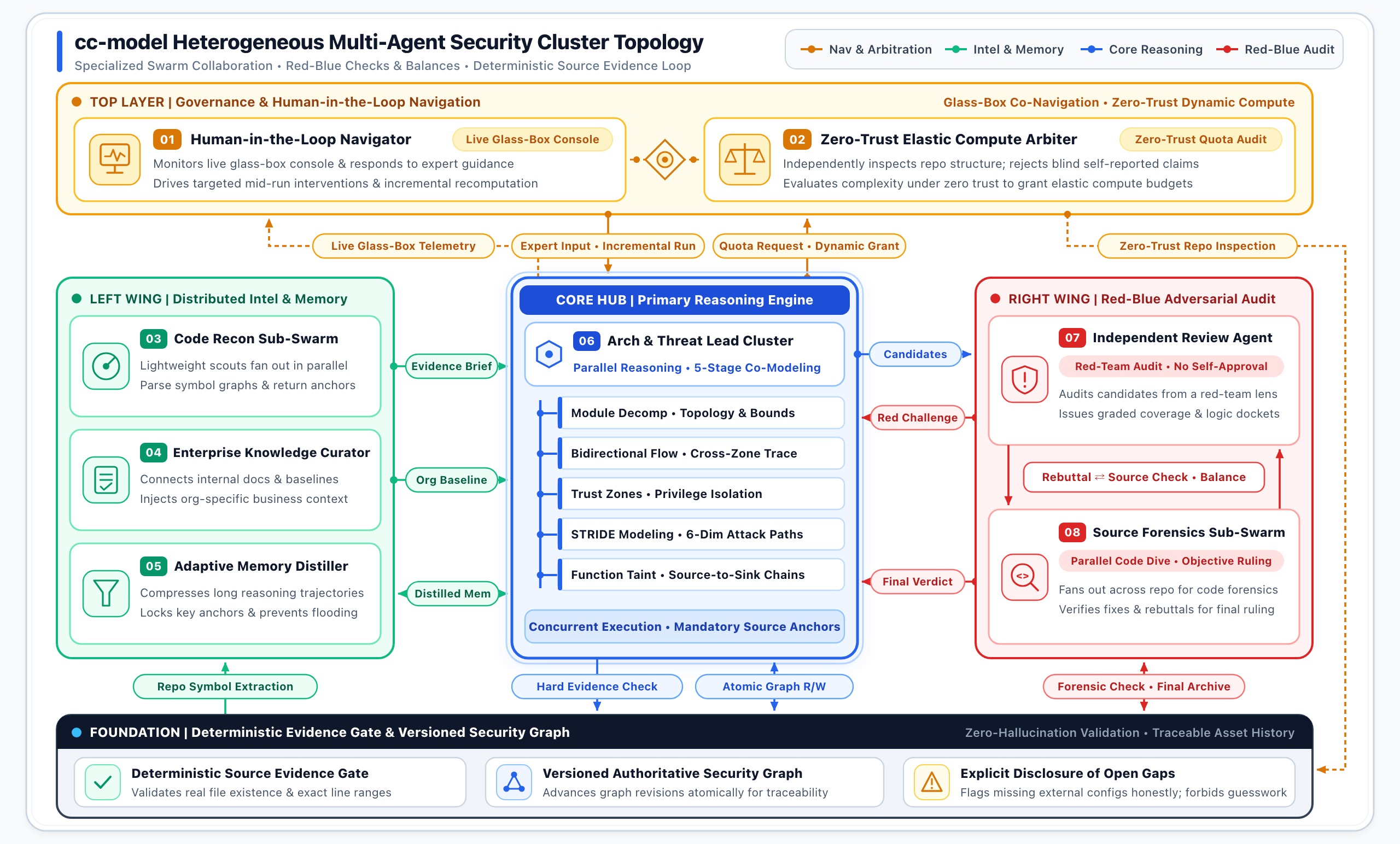
The cluster is organized into four functional domains:
- Core Reasoning Hub: The Architecture & Threat Modeling Lead Agent handles system module decomposition, bidirectional data-flow mapping, trust-zone partitioning, STRIDE threat modeling, and function-level taint modeling, advancing concurrently across modules.
- Distributed Intelligence Network: The Code Reconnaissance Sub-Swarm navigates multi-language symbol indexes to pinpoint definitions and call chains, while the Enterprise Knowledge Curator connects to internal documentation services and local security baselines to inject organization-specific business context.
- Long-Horizon Cognitive Foundation: The Adaptive Memory Distiller performs segmented semantic compression over long reasoning trajectories, keeping context size bounded while preserving decisive evidence.
- Red-Blue Adversarial & Governance Layer: The Independent Review Agent challenges candidate conclusions, while the Source-Code Forensics Sub-Swarm independently verifies disputed items against the repository; the Zero-Trust Elastic Compute Arbiter governs compute budget expansion, and the Human-in-the-Loop Navigator translates expert feedback into targeted interventions and incremental recomputation.
Separating Commanders from Scouts to Prevent Context Overload
When a conventional code-auditing agent confronts a large repository, a familiar failure mode appears: to understand one low-level helper, it reads dozens of files in sequence until local implementation trivia crowds out global architectural awareness.
cc-model separates local code reading from global architectural reasoning. The lead agent stays focused on system-level structure; whenever implementation details require deep inspection, it dispatches multiple Code Reconnaissance sub-agents in parallel. Each scout receives a tightly scoped investigative question and returns only a concise finding summary paired with exact line-level source coordinates.
Strict context isolation and read-only permission boundaries sit between reconnaissance sub-agents and the lead agent: scouts cannot pollute global task memory or alter primary objectives, keeping exploration broad without losing control.
As long-horizon reasoning approaches context watermarks, the Adaptive Memory Distiller extracts structured summaries from prior exploration traces, retaining verified source anchors and core hypotheses to prevent mid-audit amnesia.
No Finding Clears Review by Self-Approval
In LLM-driven security workflows, the greatest danger is not that a model makes a mistake, but that it grades its own homework — generating a claim, skimming it once, and declaring it valid.
To prevent this, cc-model enforces a closed loop of generation, adversarial challenge, independent forensics, and state-machine adjudication.
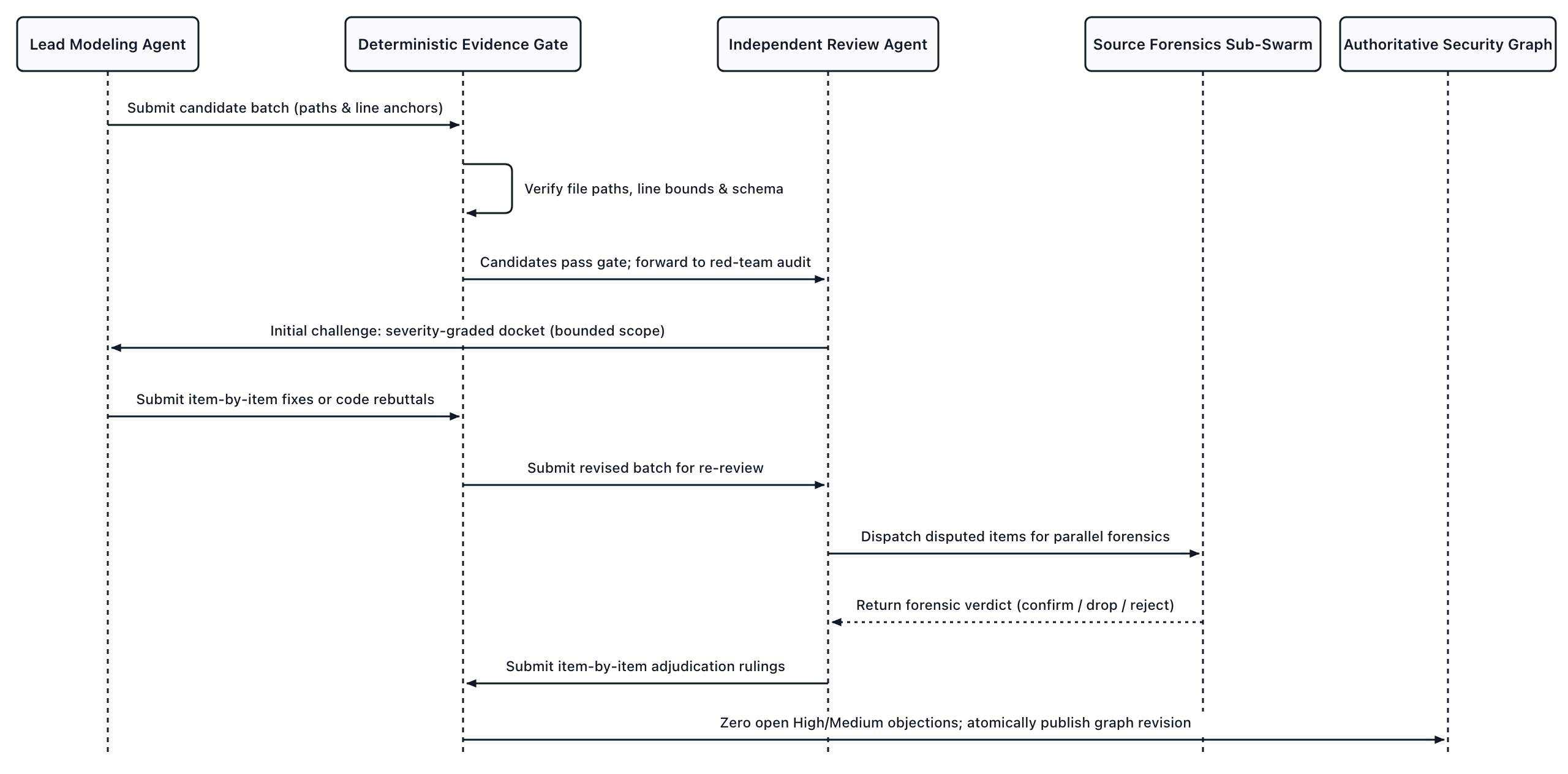
- Independent review with bounded scope. The Independent Review Agent examines candidate outputs from a red-team perspective and issues a structured, severity-graded list of objections. Re-review stays locked to open docketed items, requiring the working agent to deliver either substantive fixes or source-backed rebuttals item by item — never waving issues away.
- Concurrent forensics directly against source code. When presented with fix claims or rebuttals, the reviewer dispatches multiple Source-Code Forensics sub-agents in parallel. Each verifier investigates a single disputed item, inspects the repository independently, and submits a line-referenced verification report.
- State-machine adjudication rather than verbal sign-off. Task completion is never decided by a model's conversational approval; an underlying state machine determines closure strictly by checking whether unresolved high- and medium-severity objections have reached zero.
Even when deeper analysis demands extra compute, the lead agent cannot expand its own quota. The Zero-Trust Elastic Compute Arbiter treats expansion requests as untrusted claims, independently inspects directory boundaries and deployment topology, and approves additional budget only where warranted — balancing compute discipline against coverage of critical modules.
03 | From Architectural Semantics to Code Defects: Closing the Last Mile
Traditional threat modeling typically stops at human-readable documents, whereas traditional static analysis misses critical entry points for lack of business context. cc-model bridges the two through an eight-stage progressive pipeline:
Code Indexing → Project Comprehension → Module Decomposition → Bidirectional Data-Flow Mapping → Trust-Zone Partitioning → STRIDE Threat Modeling → Function-Level Taint Modeling → Panoramic Report Export
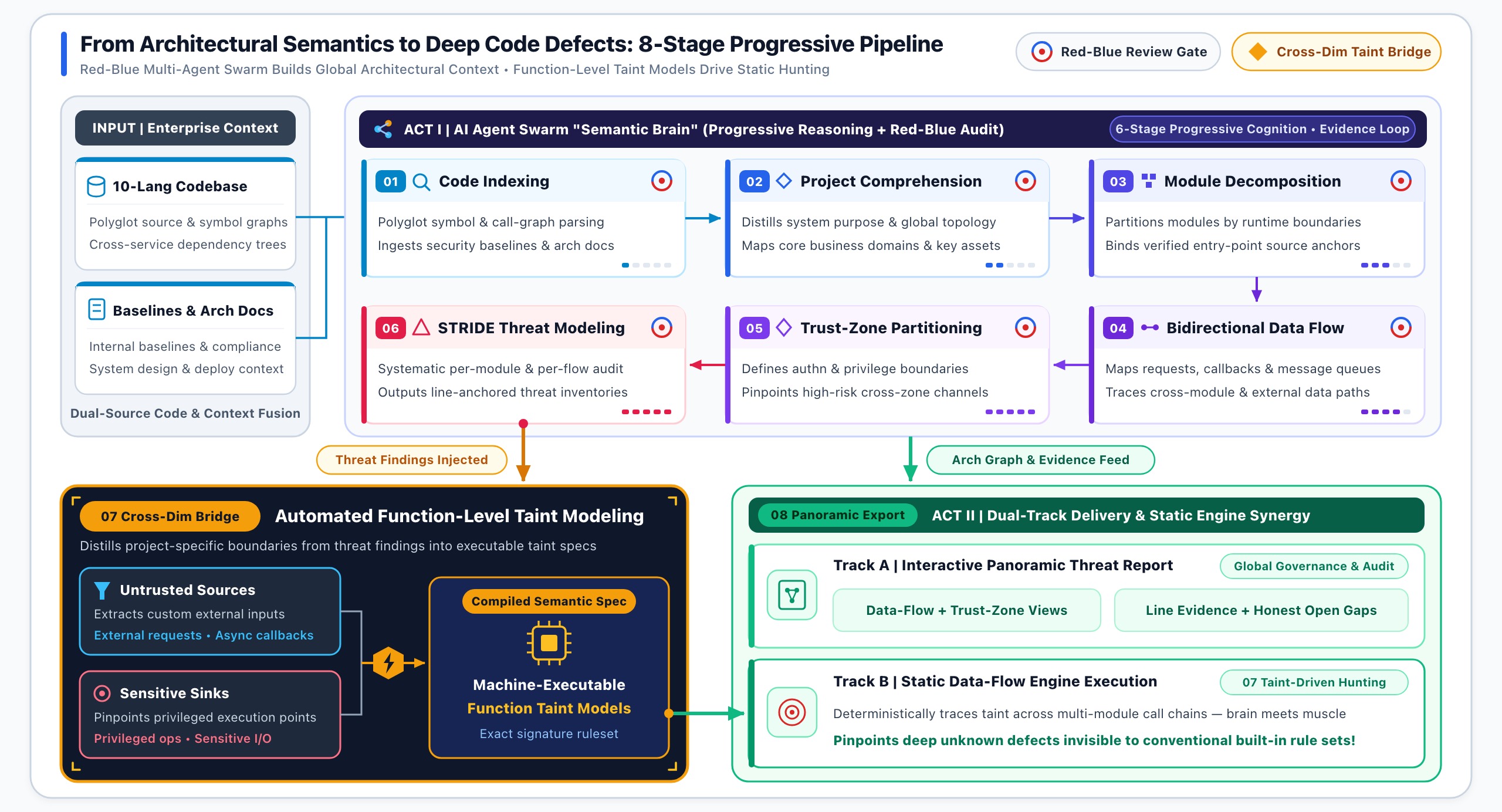
The centerpiece of this pipeline is the fusion of an LLM semantic brain with deterministic static-analysis muscle:
- The AI agent cluster decodes project semantics. It identifies project-specific architecture, custom protocol wrappers, and business entry points — determining which functions ingest untrusted input, what risk assumptions apply, and where sensitive operations occur — then compiles tailored function-level taint models.
- The static data-flow engine performs deterministic tracking. Loaded with those custom taint models, the engine traces taint propagation across complex multi-file, cross-module call chains to pinpoint deep defects unreachable by generic built-in rules.
The former solves the blindness to unfamiliar business abstractions; the latter overcomes the inability of pure LLMs to trace ultra-long call graphs reliably.
Constraining Hallucinations with Hard Source Evidence — and Honest Open Gaps
For enterprise security teams, unfalsifiable AI guesswork erodes trust faster than false negatives. At the cluster foundation, cc-model enforces three trustworthiness guardrails:
- Strict line-level evidence validation: Every submitted module boundary, cross-zone data flow, and threat entry must carry real repository paths and exact line ranges, which the system verifies for file existence and range validity.
- Entity disambiguation and versioned graphs: External systems and data stores are merged solely on identity evidence; every approved review advances the global security graph revision atomically, ensuring every conclusion traces back to a specific architectural snapshot.
- Explicit disclosure of Open Gaps: When local configurations or external contracts are absent, agents are forbidden from filling blanks by conjecture. Instead, unknowns are logged explicitly as Open Gaps for human security engineers to verify.
Rather than masking uncertainty behind polished placeholders, cc-model explicitly records where external configuration evidence is missing and flags it as an Open Gap for review.
Operationally, cc-model supports role-based compute allocation, checkpoint resumption, and fault handoff. A real-time web console surfaces pipeline watermarks, agent collaboration trees, tool invocation traces, and red-blue review rounds. Security engineers can supply authentication assumptions, adjust trust zones, or trigger module re-audits in natural language, driving targeted downstream recomputation with full revision history.
04 | Real-World Engineering Benchmarks: From Threat Modeling to Zero-Day-Class Defect Discovery
The value of a multi-agent security cluster must ultimately be proven on production-grade codebases.
nginx 1.28.1: 60x Validated Threat Detections
Using the same underlying foundation-model family, cc-model was benchmarked head-to-head against the open-source threat-modeling tool STRIDE-GPT across the complete nginx 1.28.1 source tree. Every threat reported by either tool underwent blind, source-level manual review by security specialists.
| Evaluation Dimension | cc-model | STRIDE-GPT |
|---|---|---|
| Total automated threats generated | 205 | 11 |
| Confirmed valid by manual source audit | 122 | 2 |
| Threat precision (confirmation rate) | 59.5% | 18.2% |
| Evidence granularity | Preconditions, blast radius, and exact source line anchors | High-level conceptual descriptions |
cc-model delivered 60x as many validated threats as the baseline while lifting precision by 41.3 percentage points — roughly 3.2x the baseline accuracy.
On complex industrial codebases, the real moat lies not in isolated prompt tricks, but in an engineering system that combines hierarchical exploration, adversarial verification, and deterministic evidence constraints.
giflib 5.1.2: Catching an Out-of-Bounds Read Where Baseline Scanners Raised Zero Alerts
Beyond architectural threat modeling, cc-model drives static analysis to catch concrete code defects. On the classic open-source image library giflib 5.1.2, the cluster completed the entire chain — from exposing a dead validation check to pinpointing a previously unknown out-of-bounds memory read — with zero human intervention.
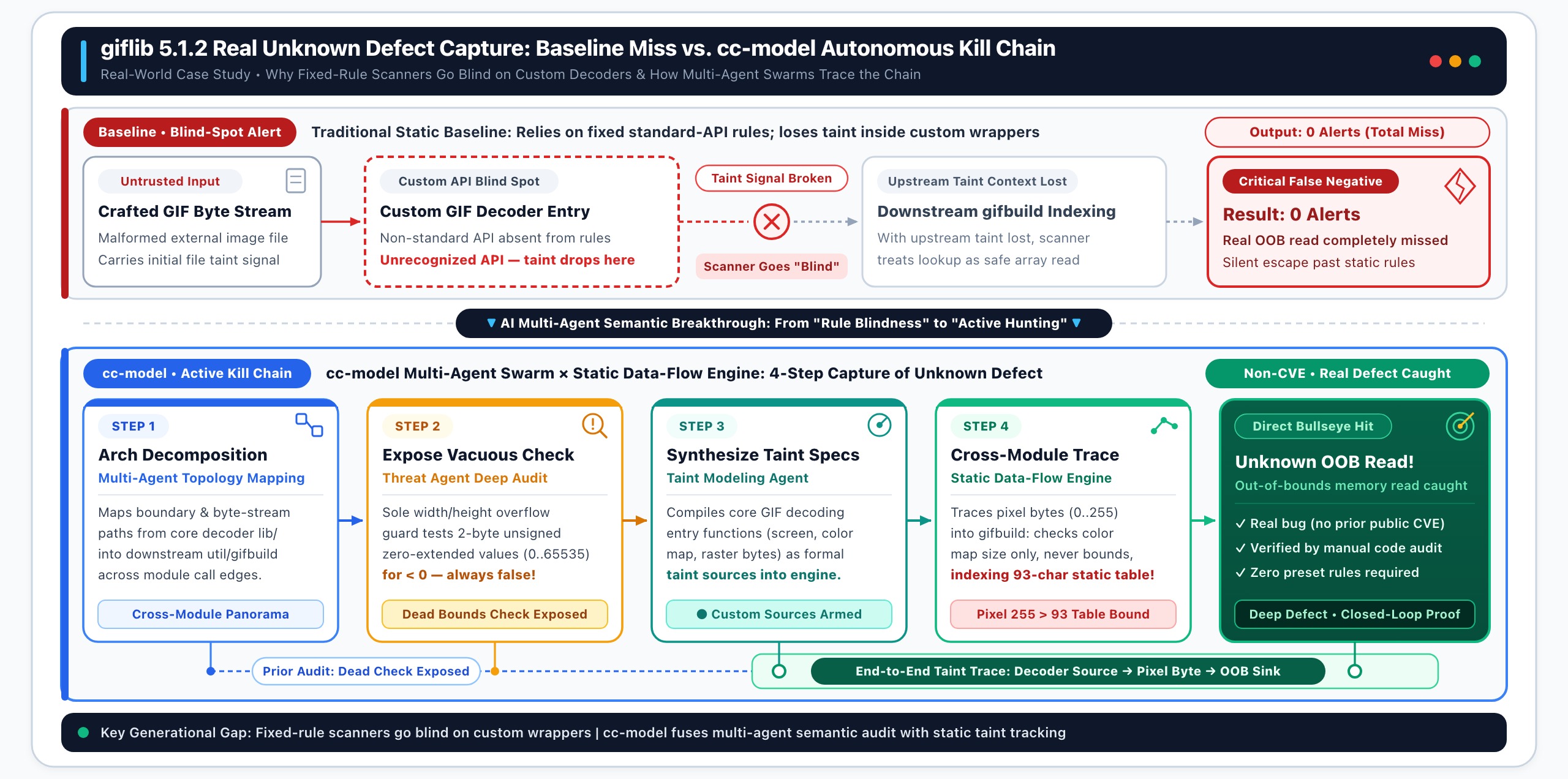
- Automated module and data-flow decomposition. The cluster mapped the boundary and byte-stream paths between the core image-decoding library and downstream command-line utilities.
- Exposing a vacuous bounds check. Threat-modeling agents discovered that the codebase's sole integer-overflow guard on image width and height tested whether two-byte unsigned zero-extended values were less than zero — a condition that is mathematically always false, rendering the check dead code and letting crafted images pass unimpeded.
- Synthesizing function-level taint models. Taint-modeling agents distilled the core decoding entry functions responsible for reading screen descriptors, color maps, and raster bytes into formal taint-source specifications and injected them into the static data-flow engine.
- Cross-module tracking to the out-of-bounds read. Tracing taint across files into the downstream
gifbuildutility, the engine found that decoded pixel bytes ranging from0to255were checked only against color-map metadata — never validated against pixel value bounds — before indexing directly into a static 93-character lookup table, triggering an out-of-bounds memory read.
Manual source-level verification by security researchers confirmed that the defect is genuinely triggerable and corresponds to no known public CVE. Under a conventional static-scanning baseline without cc-model's generated taint specifications, this location produced 0 alerts; once loaded with the cluster's autonomously synthesized entry-point taint models, detection is deterministic and reproducible.
05 | Integrating into Enterprise R&D and AppSec Workflows
Sophisticated agent architecture matters only insofar as teams can deploy and trust it in daily engineering. cc-model packages four core capabilities for enterprise development and security organizations:
- Ten mainstream programming languages: Supports C, C++, Java, Python, Go, Rust, TypeScript, JavaScript, C#, and Kotlin — fitting polyglot microservices and low-level systems repositories alike.
- Four high-value operational scenarios: Covers pre-release security assessments, major architectural security reviews, red-blue audit lead generation, and deep custom defect hunting in foundational C/C++ software.
- Private, low-dependency deployment: Ships as a single self-contained executable requiring no heavy runtime setup on target hosts, connecting via standard APIs to public cloud LLMs or on-premises model gateways so proprietary source code and institutional knowledge stay inside internal network boundaries.
- Traceable multi-format deliverables: Produces standalone offline interactive HTML panoramic reports embedding data-flow diagrams, trust-zone views, and source evidence snippets, alongside structured machine-readable artifacts and diagram source files ready for enterprise DevSecOps pipelines.
Conclusion | The Next Phase of AI Security Is Organizational and Engineered
As software systems continue to grow in scale and coupling, defenses built solely on manual review and fixed static rules face diminishing returns.
Using a heterogeneous multi-agent cluster as its fulcrum, cc-model bridges the divide between code syntax and architectural semantics — turning AI from a sidecar Q&A assistant into a 24/7 digital security team grounded in hard source evidence, fluent in business boundaries, and capable of autonomously hunting deep unknown defects.
Moving from solo blind guessing to coordinated swarms is not merely about multiplying agent count; it is about making structured collaboration, adversarial checks and balances, and deterministic evidence constraints the core infrastructure of AI security engineering.